Physics Games Explained: Momentum, Balance and Timing
Why do some browser games feel so real? Learn how momentum, balance and timing work in physics games, with practical tips for Basket Battle, Scooter Xtreme and Bumper.io.

Some games follow neat, predictable rules: a piece moves one square, a tile slides until it hits a wall. Physics games are different. Objects have weight, speed and bounce, and they react to each other the way real things do. That is what makes a basketball rattle around the rim or a scooter wobble after a hard landing. Understanding a few simple ideas behind these games makes them easier to play well.
What a physics engine does
A physics engine is the part of a game that moves objects for you. Many times every second, it works out the forces acting on each object, such as gravity, a push from the player or a collision, and updates where every object is and how fast it is moving. On CrazyFunPlay, games like Basket Battle, Scooter Xtreme and Bumper.io use a 2D physics engine that runs right in your browser, so there is nothing to install.
Because the engine calculates movement instead of playing back fixed animations, no two shots, jumps or crashes are exactly the same. Small differences in timing or speed lead to different results. That is why these games feel lively, and why practice pays off.
Idea 1: Momentum carries you forward
Momentum is how hard it is to stop something that is moving. A heavy, fast object has lots of it; a light, slow object has little. In physics games, momentum decides who wins a collision and how far things travel after a push.
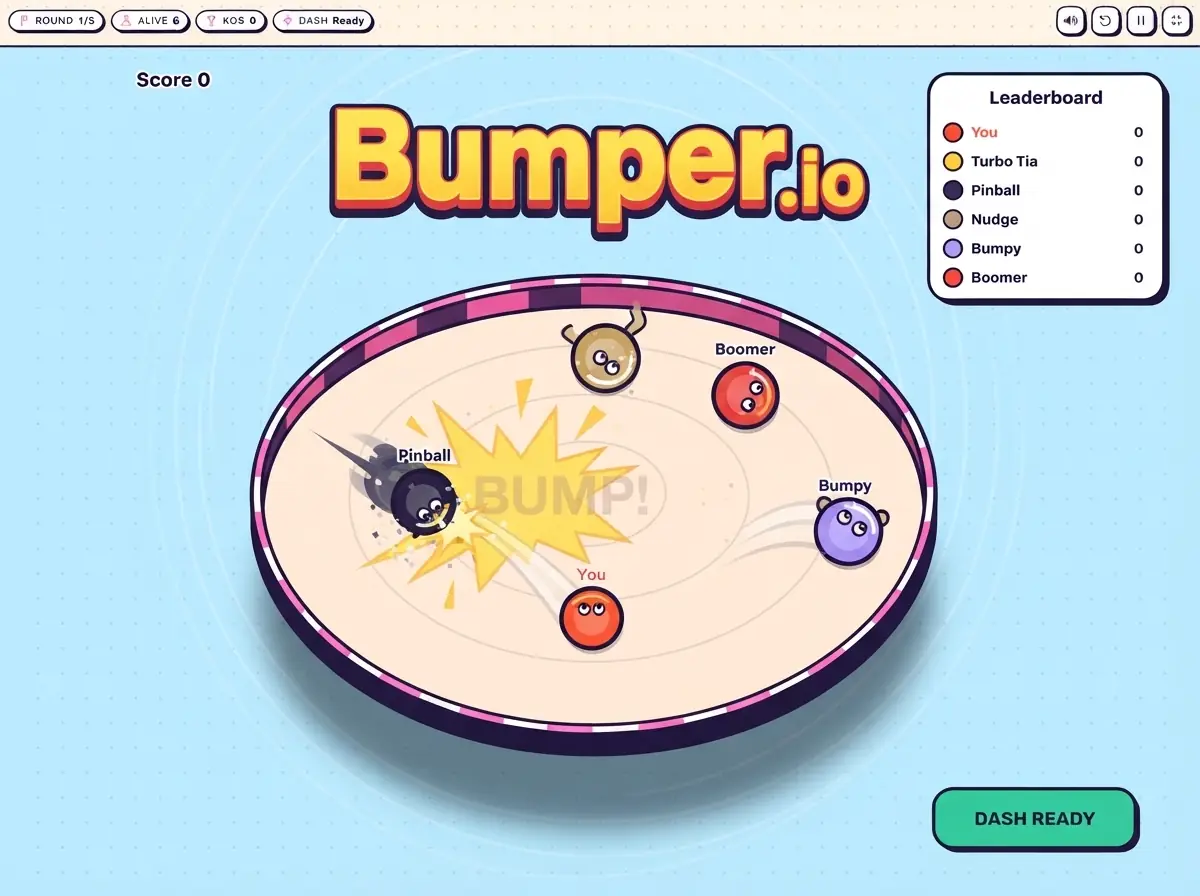
You can feel this in Bumper.io. When two cars meet, the one that is moving faster, or is heavier, pushes the other one back. A dash gives you a burst of speed, so a well-aimed dash sends a rival sliding towards the edge. Picking up the heavy power-up makes you harder to push, because more weight means more momentum for the same speed.
Tips for Bumper.io
- Attack from the centre side of the arena so the push sends rivals outwards, not past you.
- Save your dash for a clean, head-on hit. A glancing blow wastes most of your momentum.
- Stay near the middle when the platform shrinks. Near the edge, even a small push is enough to knock you out.
Idea 2: Balance depends on where the weight sits
Anything that can tip over has a centre of mass, the point where its weight is balanced. If the centre of mass moves too far forward or back, the object rotates. A rider on a scooter is a perfect example.
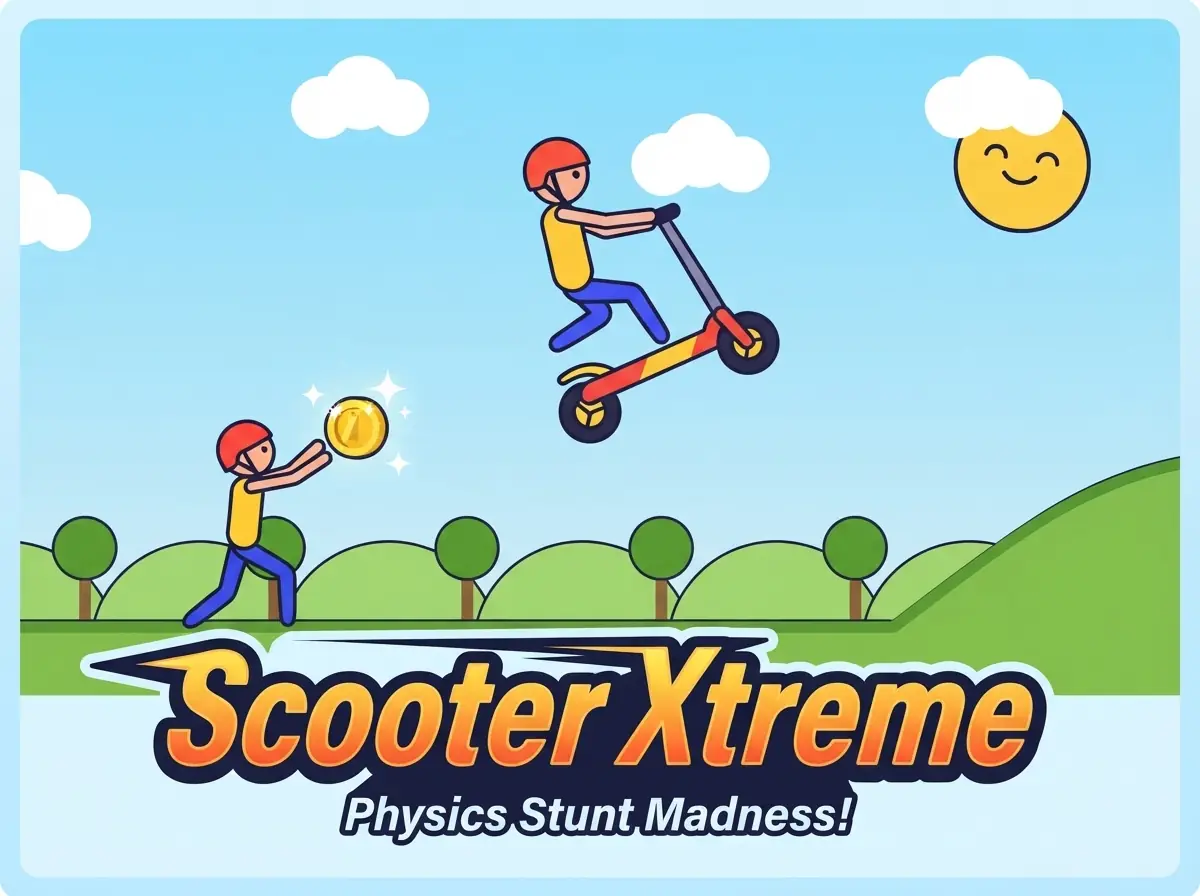
In Scooter Xtreme, leaning back shifts weight towards the rear wheel and leaning forward shifts it towards the front. On the ground, this helps you climb steep slopes or stop the front wheel lifting. In the air, leaning makes the scooter rotate, which is how you spin a flip. The trick is stopping the rotation at the right moment so you land on both wheels.
Tips for Scooter Xtreme
- Ease off the gas before a big drop. Too much speed off a ramp makes it hard to control the rotation.
- Lean back slightly as you land so the rear wheel touches down first and absorbs the impact.
- Flips are easiest off steep ramps with plenty of speed, because you get more time in the air.
- If you are stuck on an awkward slope, respawning at the last checkpoint is often quicker than fighting it.
Idea 3: Timing turns physics into skill
Physics is predictable in the sense that the same input at the same moment gives a similar result. That makes timing the key skill. Release a basketball at the top of your jump with the right power and it follows a smooth arc into the hoop. Release it a fraction early and it clangs off the rim.
Basket Battle shows this with its shot meter. The ball's path depends on how long you hold the shoot button, and a release in the green zone gives the cleanest arc. Once the ball is in the air, the engine takes over: it can bounce off the backboard, spin off the rim or drop straight through.
Tips for Basket Battle
- Watch the meter, not the ball, while you hold shoot. A release in the green is far more accurate, especially from long range.
- Drive to the rim when the defender is slow. Dunks are almost guaranteed once you get there.
- Jump to block just as the CPU releases its shot, not before.
- Try steals when the CPU is dribbling close to you, where the ball is easiest to reach.
Idea 4: Joints and ragdolls add personality
Some physics games connect several shapes with joints, a bit like a puppet. This is called a ragdoll: the head, body, arms and legs are separate pieces linked at the neck, shoulders and hips, and the engine moves each piece on its own. In Stickman Fighter, the losing fighter turns into a ragdoll at the moment of the knockout and tumbles away from the final blow, so every knockout looks a little different.
Why physics games are worth practising
Physics games reward the same kind of learning we use in real life: you try something, watch what happens and adjust. After a few rounds you start to feel how far a dash will push a rival or how long to hold a lean before landing. That feeling of growing control is what makes these games so satisfying.
Final thoughts
Momentum decides who wins a collision, balance decides whether you land or crash, and timing turns both into skill. Keep those three ideas in mind and you will improve faster in any physics game. Ready to practise? Jump into our Sports games or test your reflexes in the Arcade games category.