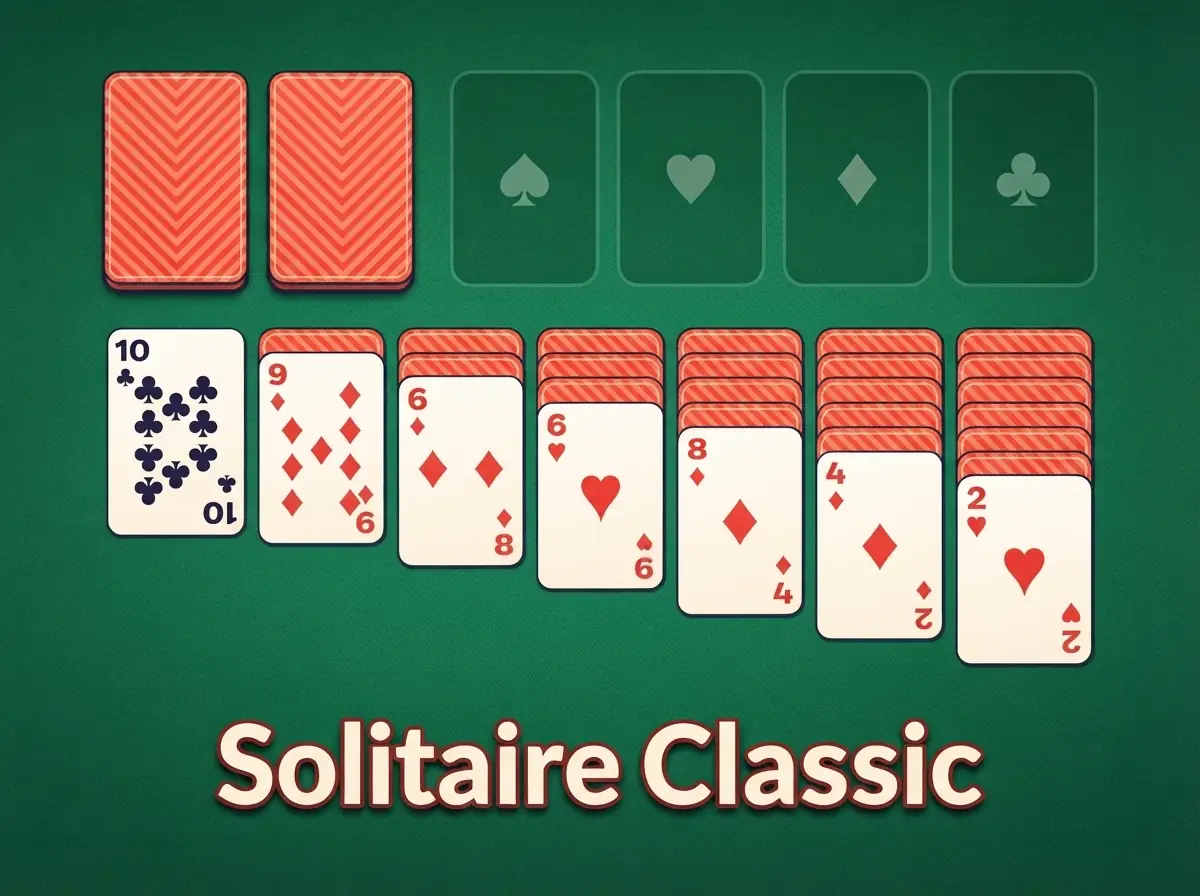
Klondike Solitaire Strategy: 10 Tips to Win More Games
Win more Klondike solitaire games with ten practical habits: which cards to free first, when to fill empty columns and how to play draw 3 without guessing.
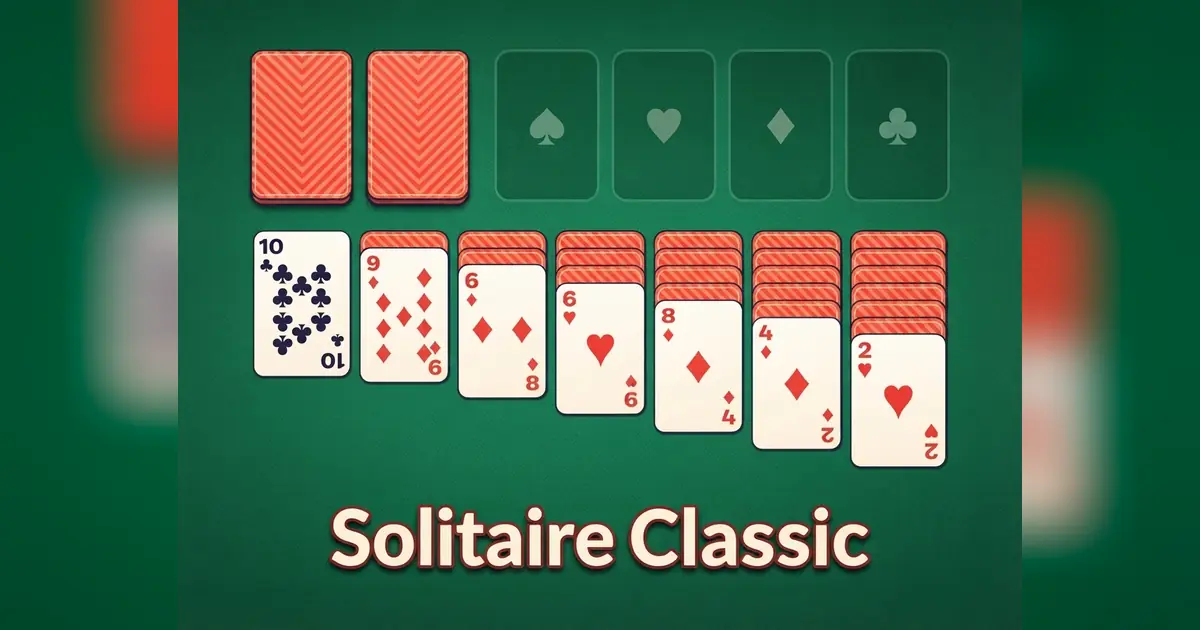
Klondike is the version of solitaire most people picture: seven columns of cards, a stock pile in the corner and four empty foundations waiting for the Aces. It looks like a game of luck, and some deals really cannot be won. But a large share of losses come from small, avoidable choices made early in the game. These ten habits will help you win more often in Solitaire Classic or any other Klondike game.
A quick refresher on the rules
You build down the seven tableau columns in alternating colours: a black 8 can go on a red 9, a red 7 on that black 8, and so on. Only a King, or a run starting with a King, can fill an empty column. Each foundation is built up in one suit from Ace to King. When you run out of moves, you draw from the stock: one card at a time in draw 1, or three at a time in draw 3, where only the top card of the three can be played.
1. Free face-down cards first
Every face-down card in the tableau is information you do not have yet. When you are choosing between two moves, prefer the one that turns a hidden card face up. A move that only shuffles face-up cards around rarely changes your position, while a newly revealed card can open up several moves at once.
2. Start with the biggest columns
The column on the far right starts with six hidden cards, the one on the left with none. Hidden cards in the long columns are the hardest to reach, so when you have a choice, play from the columns with the most face-down cards. Clearing the short columns first feels productive but often leaves you stuck later with all the important cards buried on the right.
3. Do not empty a column without a King ready
An empty column is powerful, but only a King can go there. If you clear a column and have no King to move into it, you have spent several moves to create a space you cannot use. Before you empty a column, check that a King (ideally one sitting on top of hidden cards) is available to fill it.
4. Choose your King carefully
When two Kings could fill an empty column, think about what comes next. If you have a red Queen waiting to be played, a black King is the better choice. Picking the King that matches the cards you can already see saves you from blocking yourself a few moves later.
5. Do not rush cards to the foundations
Sending cards to the foundations feels like progress, and Aces and 2s should always go up straight away. Higher cards are different. A red 5 on the foundation can no longer hold a black 4 in the tableau. As a rule of thumb, only move a card to the foundation when both cards of the opposite colour, one rank lower, are already there or are not needed. Solitaire Classic will auto-move a card when you tap it, so pause for a second before tapping cards in the middle ranks.
6. Keep your options open with the stock
In draw 1 you can cycle through the stock freely, so it is fine to look before you commit. Still, play from the tableau before you draw: a tableau move might reveal a hidden card that changes which stock card you need.
7. Plan ahead in draw 3
Draw 3 is harder because the order of the stock matters. Each time you take a card from the waste pile, every later group of three shifts by one card. Before playing a card from the waste, ask yourself whether you want the stock order to change. Sometimes it is better to pass on a playable card so that a more useful card comes up on the next pass.
8. Move runs to unblock, not just to tidy
You can move a whole face-up run onto another column if the top card fits. Do it when it achieves something, such as revealing a hidden card or freeing a column for a King. Moving runs back and forth between two columns of the same colour pattern wastes time and can hide which card you actually need.
9. Use undo to test ideas
Solitaire Classic offers unlimited undo, and that is a learning tool as much as a safety net. If you are unsure between two lines of play, try one, see what it uncovers and undo if it leads nowhere. Over time you will start to recognise which choices tend to work, and you will need undo less often.
10. Accept that some deals cannot be won
Even perfect play cannot win every Klondike deal, especially in draw 3. If you have tried the obvious ideas and the stock has nothing left to give, start a new game rather than forcing it. Comparing your results on the daily deal is a fair way to measure progress, because everyone gets the same cards.
A simple routine for every game
- Move any Aces and 2s to the foundations.
- Look for moves that turn over a hidden card, starting with the longest columns.
- Only empty a column when a King is ready to fill it.
- Draw from the stock when the tableau has no useful moves.
- Hold back middle cards from the foundations until they are no longer needed.
Final thoughts
Klondike rewards patience and a little planning. Reveal hidden cards, protect your empty columns and think one move ahead before every tap. If you enjoy calm games that reward careful sorting, try Water Sort Online or browse more relaxed picks in our Casual games category.